SONIC LOGGING TEST (SLT)
Pile & Foundation
Dynamic Load Test (PDA)
Pile Integrity Test (PIT)
Sonic Logging Test (SLT)
Pile Maintain Load Test (MLT)
Soil Testing
Soil Investigation (SI)
Mackintosh Probe Test (MPT)
Field Density Test (FDT)
Standard Proctor (SP)
Cone Penetration Test (CPT)
California Bearing Ratio (CBR)
Plate Bearing Test (PBT)
Civil Material Laboratory
Compressive Strength Test
(CST)
Rebound Hammer Test
Windsor Probe Test
Ultrasonic Pulse Velocity (UPV)
Steel Bar Tensile Test
Aggregate
Bitumen
Geotechnical Laboratory
Laboratory Test
Instrumentation & Monitoring
Vibration Monitoring (VM)
Vibrating Wire Piezometer
Pneumatic Piezometer
Standpipe Piezometer
Inclinometer
Magnetic Extensionmeter
Tilt Meter
Settlement Plate
Water & Air Monitoring
Effluent & Waste Monitoring
Noise
Monitoring
Monitoring for EIA
Occupational Safety and Health Monitoring
SONIC LOGGING TEST
The Sonic Logging Technique , also known as Cross Hole Ultrasonic Method (CHUM) is used to determine the defect in cast in-situ piles, caisson, barrettes and diaphragm walls. Such tests can produce an economic survey of each pile to complement the more expensive capacity testing which is restricted to a small percentage of piles.
The homogeneity of a foundation pile is very important in order to ensure its serviceability to support the load transferred from the building or structure constructed. Phenomena such as honeycombing due to inadequate vibration, segregation due to over vibration and improper concrete placement method, wash out of cement, cracks in the pile shaft, inclusion, necking and arching of the pile due to collapse of side walls during withdrawal of the temporary liners are very common in construction of bore piles. Therefore, effort must be taken to ensure each pile installed on site to be free from any kind of defects during the installation.
The Sonic Logging Test can be the most suitable method to detect the defects of the piles that are mentioned above. In homogeneous concrete, free from defect and variation in quality, the velocity of "sonic" wave propagation is constant. The sonic logging technique works by way of detecting any acoustical irregularities on the sonic profiles between the access tubes. For example, a sudden increase of the travel time at any depth indicates a defect at this depth or a relatively low quality concrete has being localized. The cross hole ultrasonic method has been described in a number of recognized standards (AFNOR 1993, ASTM 2002). As we shall see later, the cross-hole method may be further refined to produce high-quality results

TESTING PROCEDURES
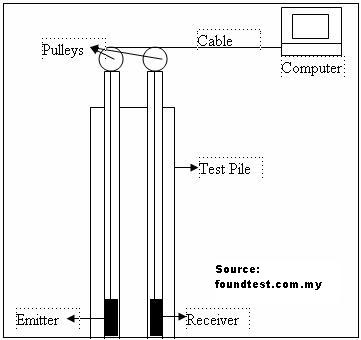
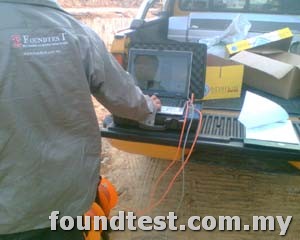
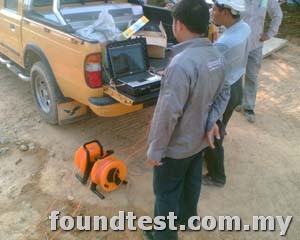
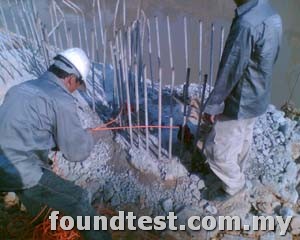
The sonic method belongs to the external test-methods, as it accesses only the top of the pile. Two probes are lowered inside two of the tubes. One of these probes is an emitter and the other a receiver of ultrasonic pulses.
Having been lowered to the bottom, the probes are pulled simultaneously upwards to produce an ultrasonic logging profile. The transmitter produces a continuous series of waves in all directions. Some of these waves do eventually reach the receiver.
The testing instrument then plots the travel time between the tubes versus the depth. As long as this time is fairly constant, it shows that there is no change in concrete quality. However, a sudden increase of the travel time at any depth indicates a defect at this depth. The cross hole method has been described in a number of recognized standards (AFNOR 1993, ASTM 2002 ).
For more information, quotation or site appointment, please call us or drop us a message here .