MACKINTOSH PROBE TEST (MPT)
Pile & Foundation
Dynamic Load Test (PDA)
Pile Integrity Test (PIT)
Sonic Logging Test (SLT)
Pile Maintain Load Test (MLT)
Soil Testing
Soil Investigation (SI)
Mackintosh Probe Test (MPT)
Field Density Test (FDT)
Standard Proctor (SP)
Cone Penetration Test (CPT)
California Bearing Ratio (CBR)
Plate Bearing Test (PBT)
Civil Material Laboratory
Compressive Strength Test
Rebound Hammer Test
Windsor Probe Test
Steel Bar Tensile Test
Aggregate
Bitumen
Geotechnical Laboratory
Laboratory Test
Instrumentation & Monitoring
Vibration Monitoring
Vibrating Wire Piezometer
Pneumatic Piezometer
Standpipe Piezometer
Inclinometer
Magnetic Extensionmeter
Tilt Meter
Settlement Plate
Water & Air Monitoring
Effluent & Waste Monitoring
Monitoring for EIA
Occupational Safety and Health Monitoring
MACKINTOSH PENETRATION TEST / JKR PROBE TEST
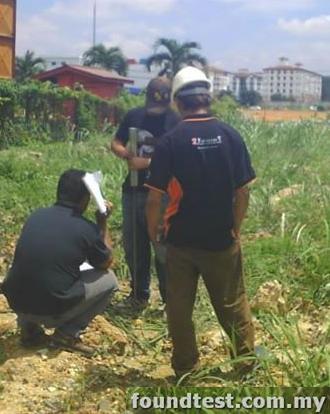
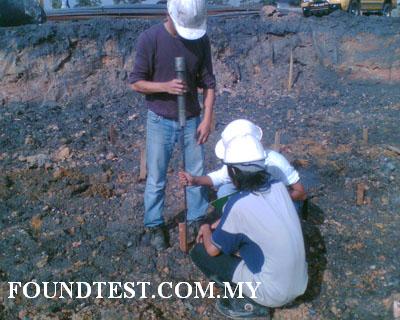
The Mackintosh Probe development was based on the principles stated by Hvorslev (1948) for drive rods for sounding and sampling and recommended methods for static and dynamic sounding by European Group Subcommittee (1968). The probe consists of a cased screwed onto the lower end of the rod. The rods are of 16mm diameter HY steel each of length 120 cm. The rods are connected to each other by 25 mm outer diameter couplings. These couplings provide the lateral support to the rods so as to prevent buckling during driving. Driving is performed with a small hammer of 5 kg in weight and falling vertically through a fixed height of 30 cm along a guide rod. The total number of blows required for the pointer to penetrate a distance of 30 cm is recorded and used as a measure of the consistency of cohesive soil and the packing of granular soil.
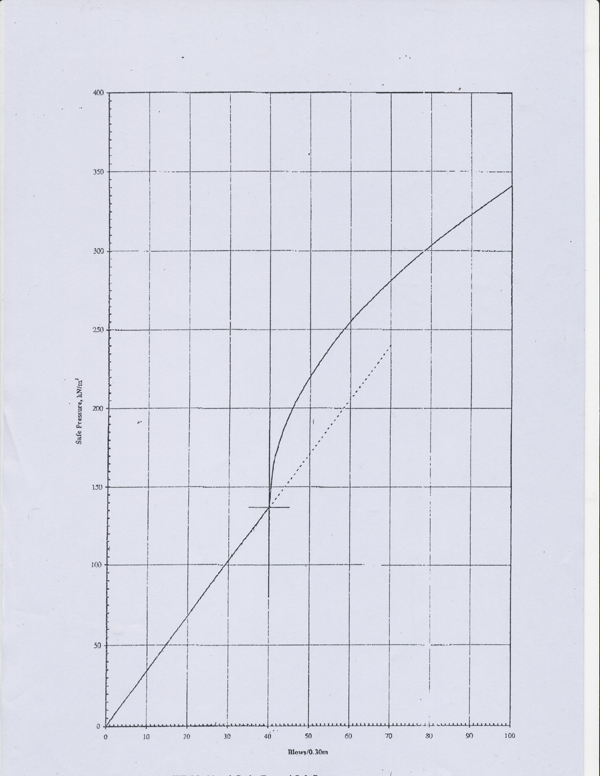
The relationship between Mackintosh Probe and Safe Pressure is as follows: -
P = (2860 + 550 (R - 40) 1/2 ) x 0.04788 kN/m 2 for blows > 40
P = Refer Chart for blows < 40Where,
P = safe pressure (kN/m 2 )
R = Mackintosh Probe Penetration resistance in blows/0.3mFor more information or site appointment, please call us or drop us a message here.